Getting Help with CCC Plus

The Virginia Department for Aging and Rehabilitative Services (DARS) and the Office of the State Ombudsman Long-Term Care have published a guide to “ensure Commonwealth Coordinated Care (CCC) Plus members can get help from a source independent of the health plan providing the services.” Advocates can “provide confidential assistance to help beneficiaries resolve problems and obtain information about grievances and appeals”, “whether in a nursing facility, assisted living facility or through community-based services”.

VAIL can provide you an electronic copy of this guide or you can call the Office of the State Ombudsman at 1-8000-552-5019 [TTY – 804-464-9950].

EVV Training Town Halls

Dear Employer of Record and Attendant,

Electronic Visit Verification (EVV) is coming!  Federal mandates require that all personal care attendants, respite providers, and companion providers clock in and out electronically for every shift.  This will begin no later than October 1, 2019, for the Commonwealth of Virginia.  Each Fiscal Agent (PPL, CDCN, and ACES$) has chosen the EVV system for their program.  All EVV systems will be demonstrated during the Town Hall events being sponsored by the Department of Medical Assistance Services (DMAS or Medicaid). 

For individuals enrolled in the CCC+ waiver:

If your insurance is: Then your fiscal agent is: And you will use this EVV System:
Aetna PPL Time 4 Care
Anthem PPL Time 4 Care
Magellan ACES$ CellTrak
Optima PPL Time 4 Care
Magellan PPL Time 4 Care
United PPL Time 4 Care
Virginia Premier CDCN CellTrak

Individuals enrolled in a DD waiver and individuals who are enrolled in HIPP: your fiscal agent is CDCN and the EVV system will be CellTrak.

EORs and attendants will need to be trained in how to use the EVV system.  Service facilitation agencies have limited information regarding these systems.  It is urgently important that you make plans to go to one of the Town Hall events to receive your training.  There is limited seating at each event, so register as soon as possible.  You should have received information from DMAS regarding these events but VAIL wanted to ensure that you had, so we are enclosing the information here.

Due to space constraints, each Employee of Record and attendant must pre-register. If you do not register, you will be unable to attend the town hall session. DMAS will use WebEx™ for the on-site registration process only. The Town Hall sessions will take place on-site at the locations identified in the letter, NOT ONLINE.

To register for the Town Hall event, go to:

  • Click here: DMAS notification
  • Click on the Registration Link for Verona.  If you are unable to attend the event in Verona, click on the registration link for the location and date you are able to attend.
Location DATE
Abingdon Thursday, July 9, 2019
Wytheville Wednesday, July 10, 2019
Roanoke Friday, July 12, 2019
Lynchburg Wednesday, July 17, 2019
Verona Thursday, July 18, 2019
Fredericksburg Thursday, July 25, 2019
Woodbridge Friday, July 26, 2019
Norfolk Wednesday, July 31, 2019
Virginia Beach Friday, August 2, 2019
Petersburg Wednesday, August 7, 2019
Richmond Friday, August 9, 2019

If you have additional questions, concerns, or if you would like to make a special accommodation request, you may contact the Office of Community Living by email at: EVV@dmas.virginia.gov.

We are highly encouraging all EORs and as many attendants as possible to register and attend Town Hall events so you can get training directly from the source.  Please see the attached schedule and register as soon as possible.

Electronic Visit Verification (EVV) is approaching!

What is EVV?

Electronic Visit Verification (EVV) uses technology to electronically record when attendants begin and end providing services to Medicaid members.  These systems require a device like a mobile phone or landline to collect the attendant’s start and end times.

Who is affected by EVV?

EVV affects all attendants providing consumer-directed personal care, respite care, and companion services to Medicaid members.  Effective October 1, 2019, DMAS will no longer accept paper timesheets.  This change is required by a new federal rule.

For more information about EVV, please join one of the informational sessions below.  To access the sessions, go to:  https://www.dmas.virginia.gov/#/longtermprograms,

The click on “Electronic Visit Verification session dates for Employers and Attendants” and then hold down theur control key on the keyboard and click on the desired link.

DATE TIME
June 18, 2019 2:00 – 3:00 PM
June 19, 2019 10:00 – 11:00 AM
June 20, 2019 4:00 – 5:00 PM
June 25, 2019 2:00 – 3:00 PM
June 26, 2019 10:00 – 11:00 AM
June 27, 2019 4:00 – 5:00 PM

Here We Grow Again

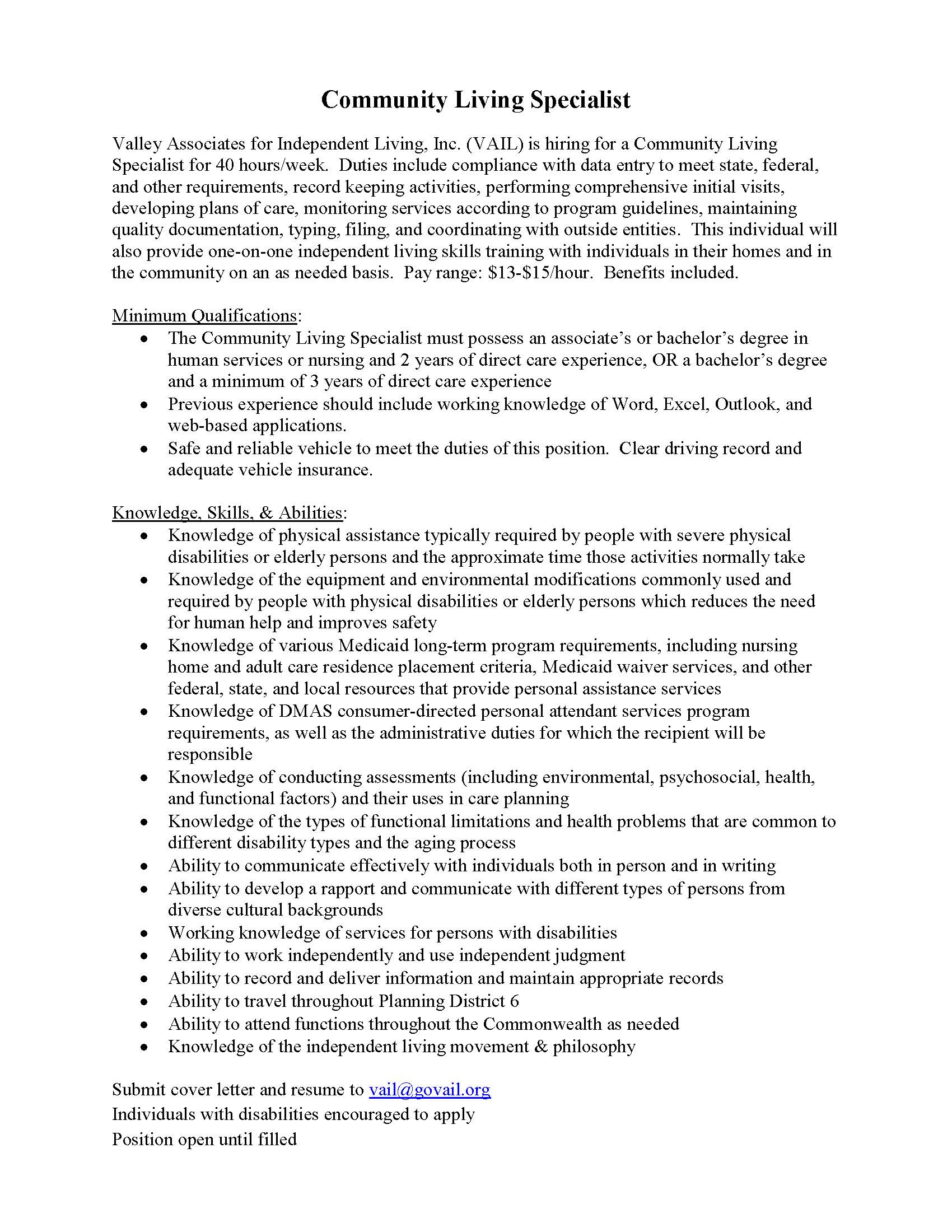
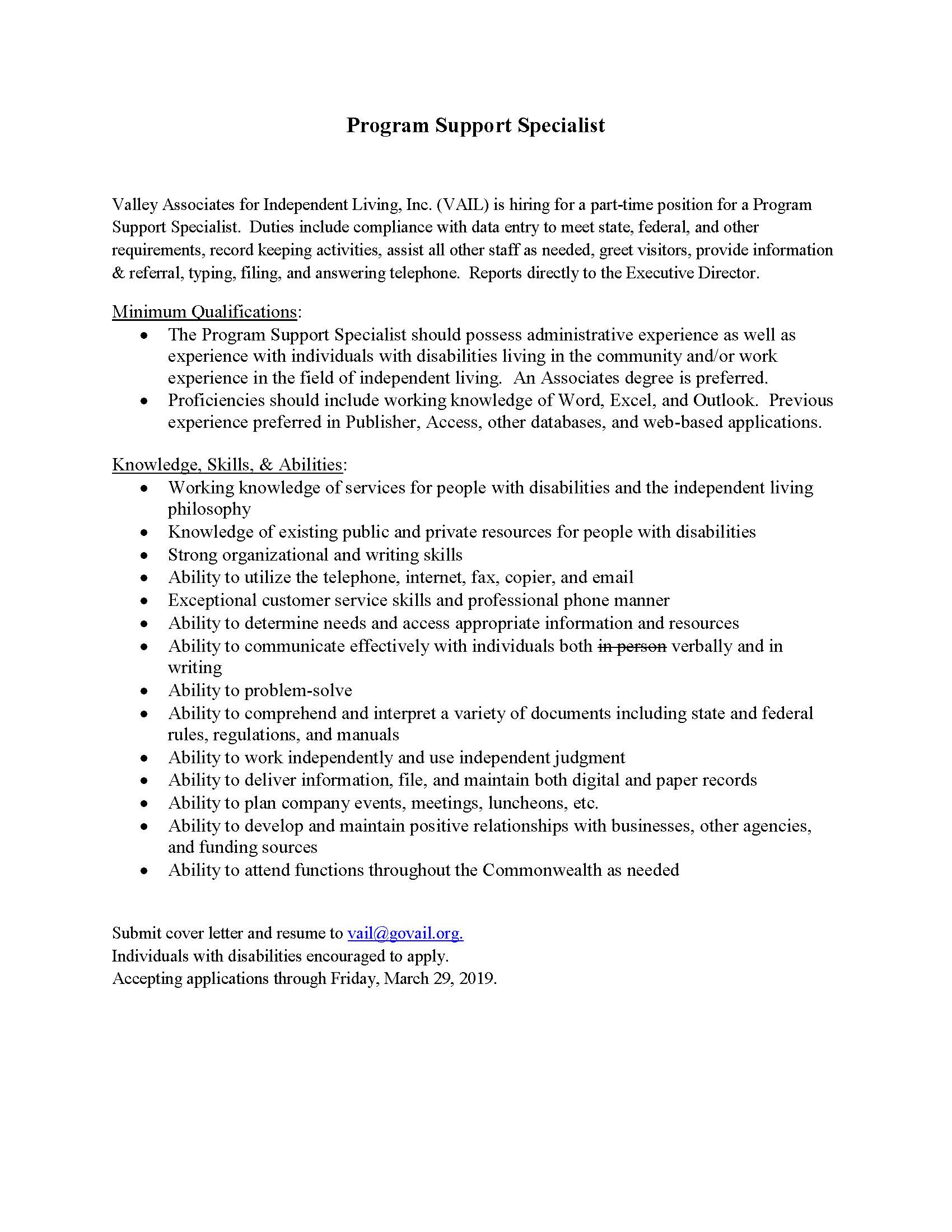
VAIL is hiring for a full-time Community Living Specialist and a part-time Program Support Specialist. Please send a resume and cover letter to vail@govail.org. Individuals with disabilities are encouraged to apply.

Impacts of Government Shutdown on Affordable Housing Programs

~ Excerpts from the Campaign for Housing and Community Development Funding (CHCDF) memo, January 15, 2019


On December 21, Congress failed to provide FY 19 funding for several federal agencies, including HUD and USDA, causing a partial government shutdown. Outlined below are the impacts the shutdown is having on HUD and USDA affordable housing and community development programs:
– As of January 5, HUD failed to renew 650 rental assistance contracts that had expired in December prior to the shutdown. The 650 contracts that HUD don’t renew in December will affect roughly 21,500 low-income households. Roughly two-thirds of these households are elderly or who have disabilities; on average, these households have incomes of less than $13,000 per year.
– The number of expiring contracts will increase as time goes on, as HUD anticipates approximately 500 additional contracts (affecting another 20,000 households) will expire and be up for renewal in January and 550 in February.
– The Section 202 program provides affordable housing to about 400,000 older adults with average annual incomes of $13,300. Contracts that provide ongoing operating subsidies to the nation’s almost 6,700 Section 202 communities are at risk of not being renewed.
– If the shutdown is not resolved by the end of February, PHAs (Public Housing Authorities) will not be able to make timely payments to landlords expecting rent subsidies on March 1. This could have dire consequences for recipients of rental assistance, as they will have to either pay their rent in full or could face eviction.
– Because of the uncertainty around funding caused by the shutdown, PHAs will be unable to approve families on the waiting list for vouchers that have been turned over by families who have exited the program. As a result, these vouchers will go unused.
– Over a quarter million families in rural communities rely on USDA rental assistance to afford a roof over their head. USDA hasn’t provided any information about housing benefits for January. If the shutdown continues, seniors, people with disabilities, families with children, and other individuals risk facing eviction, or in worst cases, homelessness.
– Homeowners who need assistance to heat their homes or repair leaky roofs are being forced to continue to live in substandard conditions.
– Congress last February appropriated $16 billion in funding to be used for projects to better safeguard communities damaged by the 2017 floods and hurricanes in Puerto Rico, Texas, Louisiana, the U.S. Virgin Islands, and Florida. HUD has yet to issue guidance for this money. The shutdown will also delay guidance for the $1.68 billion in disaster relief funding that Congress passed in October 2018 for states impacted by Hurricane Florence.

The Campaign for Housing and Community Development Funding (CHCDF) is an education, strategy and action hub for national organizations dedicated to adequate federal housing and community development funding for lower income families and communities. CHCDF’s members represent a full continuum of national housing and community development organizations, including more than 70 faith-based, private sector, financial/intermediary public sector and advocacy groups. CHCDF is staffed by the National Low Income Housing Coalition. For more information, contact Elayne Weiss, Senior Policy Analyst, at eweiss@nlihc.org or 202-507-7262.